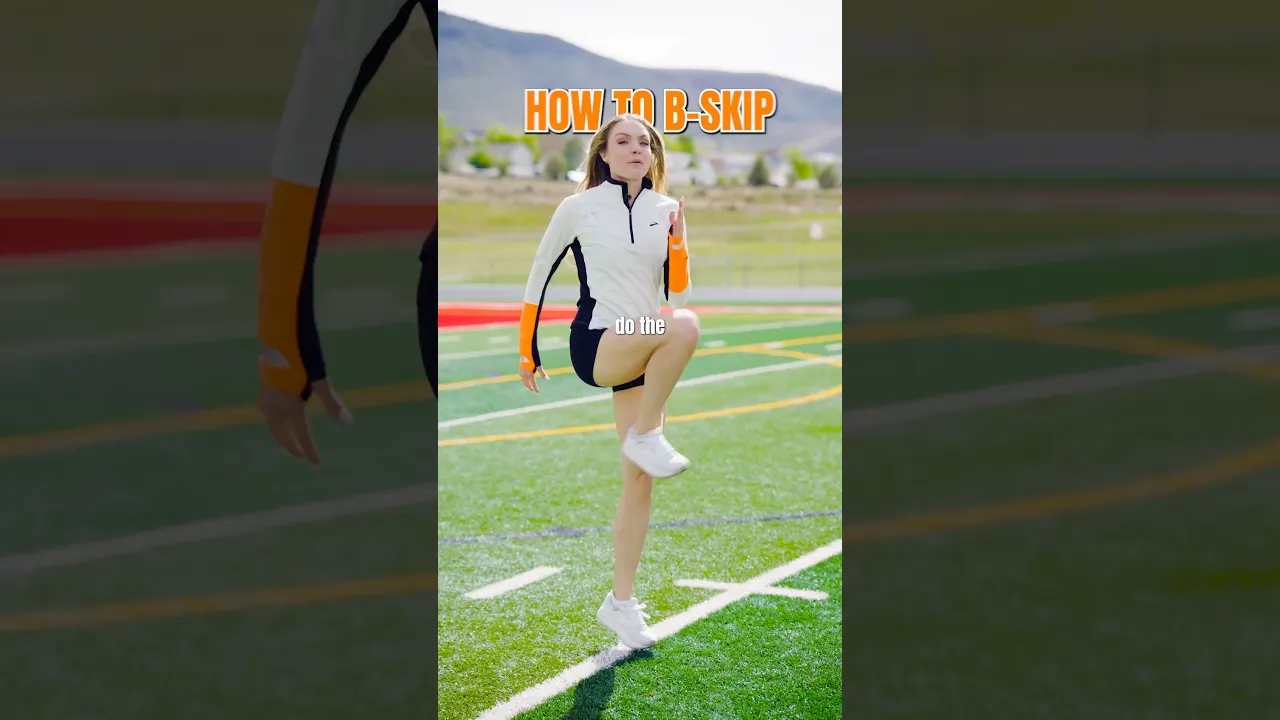
B-Skip Pro Tips! ⚡️
 Chari Hawkins
Jun 13, 2026 13:00
Create an account to hide videos, mark them watched, or save them to Don't Miss.
Create an account to hide videos, mark them watched, or save them to Don't Miss.
Create an account to hide videos, mark them watched, or save them to Don't Miss.
The B-Skip is a foundational track and field drill designed to improve your running mechanics, specifically focusing on hamstring flexibility, front-side mechanics, and a powerful leg cycle. It builds directly upon the basic A-skip by adding an active outward extension and downward "clawing" motion of the leg.
Here is a step-by-step breakdown of how to perform the B-skip with proper form:
1. Master the Rhythm (The A-Skip Base)
Before expanding the leg, you need to lock in the standard skipping rhythm.
Perform a normal forward skip where you hop twice on your supporting leg for every single drive of the opposite leg.
Keep your posture tall, your core engaged, and your eyes looking straight ahead down the track.
2. Drive the Knee Up (Front-Side Mechanics)
Aggressively drive your lead knee up until your thigh is parallel to the ground, just like you would in an A-skip or a high-knees drill.
Keep your foot dorsiflexed (toes pulled up toward your shin) to keep the ankle loaded and snappy.
3. Extend and Claw (The "B" Motion)
This is the defining feature of the B-skip:
Once your knee reaches its peak height, allow your lower leg to naturally unfold and extend forward. Do not forcefully kick or over-extend to the point where your knee locks out.
The moment the leg extends, actively whip it backward and down toward the track in a forceful, circular "clawing" or "pawing" motion.
4. Strike Under Your Center of Mass
Aggressively strike the track with your midfoot/forefoot.
Crucial Rule: Ensure your foot lands directly underneath your hips (your center of mass). Avoid reaching too far forward, which causes overstriding and acts as a brake on your momentum.
Maintain a stiff ankle to "pop" off the ground instantly, transferring that energy directly into the next skip.
5. Coordinate Your Arms
Drive your arms in a relaxed, rhythmic, oppositional motion (left arm forward when the right knee drives up).
Your arm action should match the tempo of your legs to help maintain balance and force production.
💡 Summary of the Leg Cycle
Think of the B-skip leg motion as a perfect circle: Up, Out, Down, and Back.
#brookspartner #letsrunthere @brooksrunning
Entertainment