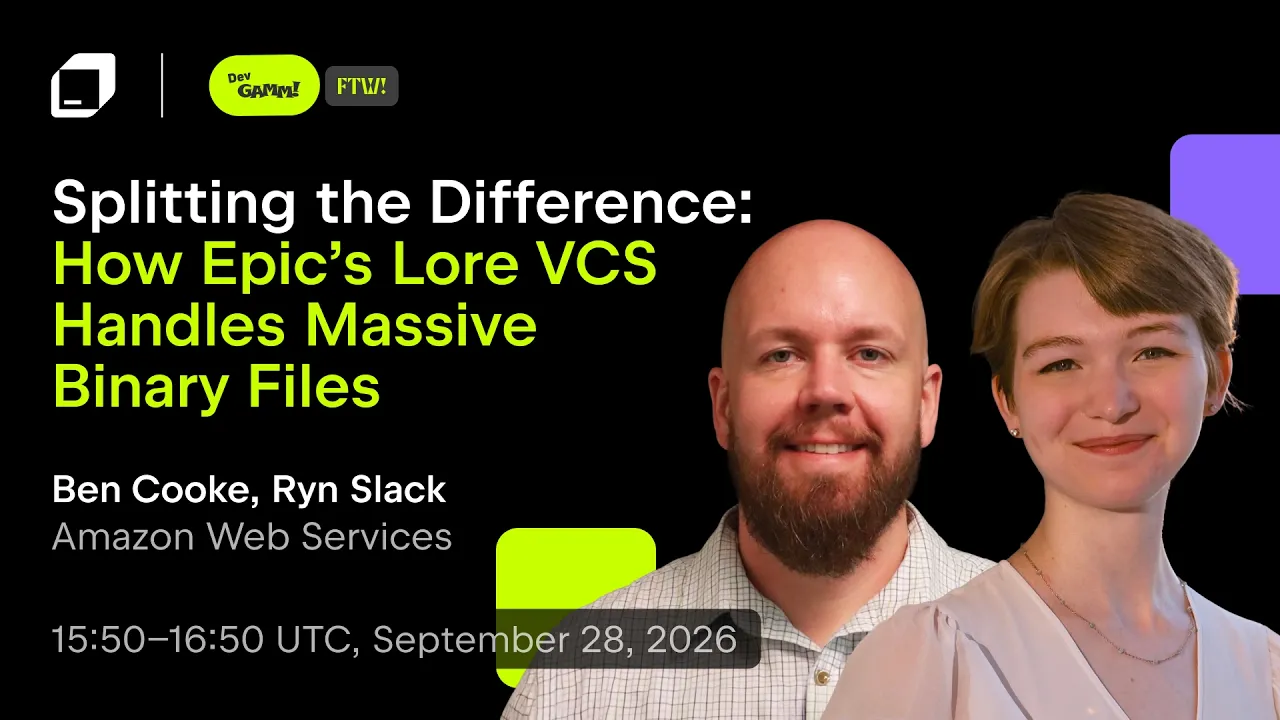
How Epic's Lore VCS Handles Massive Binary Files | Ben Cooke & Ryn Slack (AWS) | GameDev Day 2026
 JetBrains
Oct 19, 2026 14:46
Create an account to hide videos, mark them watched, or save them to Don't Miss.
Create an account to hide videos, mark them watched, or save them to Don't Miss.
Create an account to hide videos, mark them watched, or save them to Don't Miss.
Game studios have a version control problem most software teams never deal with: repositories full of huge binary files, engine assets, packaged content, textures, and audio, where a single file can be several gigabytes and changes constantly. Git snapshots every file on every commit, which stops working at that size. Centralized tools scale better, but they solve it with edge servers that hold their own working replica, something you have to size and keep in sync ahead of time.
Lore, Epic Games’ open-source VCS, doesn’t version whole files. It breaks them into content-addressable fragments, so changing part of a large asset only means moving the part that changed. That one design choice opens up more than faster commits. A new studio location or a distributed team doesn’t need a server pre-seeded with the whole repository, because an edge cache there fills in on demand as people work.
CI pipelines get the same benefit, with disposable build agents that only ever pull the fragments a given build actually touches. It works because edge caches hold no authoritative data, the durable copy always lives in cloud storage, and QUIC keeps fragment transfer fast even at real production file sizes.
In this session, Ben and Ryn walk through how this works end to end. Then, drawing on their experience as AWS Solutions Architects, they show how to deploy it yourself using the Lore module in AWS’s Cloud Game Development Toolkit.
Attendees will leave with a working mental model of fragment-based storage, an understanding of why Lore’s architecture looks the way it does, and a starting point for running it themselves.
Speakers:
Ben Cooke, Senior Games Partner Solutions Architect, Amazon Web Services
AWS for Games blog: https://aws.amazon.com/blogs/gametech/category/game-development/
Ryn Slack, Solutions Architect, Amazon Web Services
Learn more:
Lore on GitHub: https://github.com/EpicGames/lore
Lore documentation: https://epicgames.github.io/lore/
AWS Cloud Game Development Toolkit: https://github.com/aws-games/cloud-game-development-toolkit
Recorded at JetBrains GameDev Day Online 2026, a free online event for the game development community.
Watch all GameDev Day 2026 talks: https://www.youtube.com/playlist?list=PLRyISO8WW3lQ
Explore JetBrains tools for game development: https://www.jetbrains.com/gamedev/
#JBGameDevDay #VersionControl #AWS #GameDev
Science & Technology
#JetBrains
#software development
#developer tools
#programming
#developer