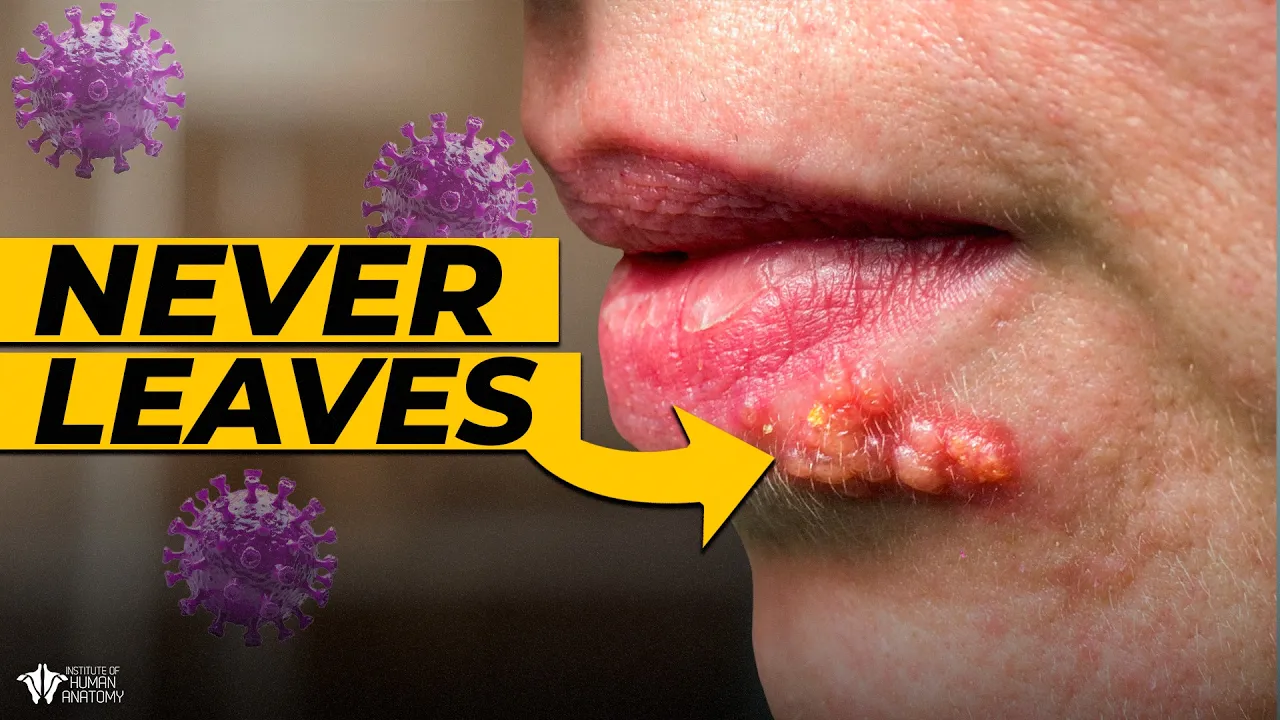
Herpes: Why It HIDES in Your Nerves Forever
 Institute of Human Anatomy
Jul 5, 2026 14:00
Create an account to hide videos, mark them watched, or save them to Don't Miss.
Create an account to hide videos, mark them watched, or save them to Don't Miss.
Create an account to hide videos, mark them watched, or save them to Don't Miss.
Chapters
Thanks to the sponsor of today's video, Hume. Use code: THEANATOMYLAB at https://humehealth.com//discount/THEANATOMYLAB?redirect=/pages/hume-body-pod&utm_source=youtube&utm_medium=influencer&utm_campaign=THEANATOMYLAB
-----
*Follow Us! + Check out Our Spotify*
https://beacons.ai/instituteofhumananatomy
🧠 * Ask AI Jonathan!*
https://www.instituteofhumananatomy.com/jonathan-ai
----
Could a common viral infection permanently alter your nervous system and quietly hide inside your nerve pathways for the rest of your life? Discover the startling microbiology of the Herpes Simplex Virus—and how it successfully evades your immune defenses to become a permanent lifelong resident.
In this video, Jonathan from the Institute of Human Anatomy takes you deep into neurological and dermatological physiology to unmask how both HSV1 and HSV2 interact with human tissue. We trace the entire viral assembly line: from how particles infect superficial epithelial cells across your skin and mucous membranes, to the exact mechanism they use to travel up sensory neurons to take up permanent residence in sensory ganglia like the trigeminal and sacral ganglia.
You will discover why many individuals remain entirely asymptomatic during primary exposure, explore the exact triggers behind painful viral reactivations (such as stress, sunlight, and illness), and learn how common oral antiviral therapies strategically inhibit viral replication to give your immune system a head start.
----
Table of Contents
----
Common Questions
Why can't the human immune system completely cure or eradicate herpes? After its initial primary infection of surface epithelial cells, the virus travels backwards along nearby sensory neurons to the nerve cell bodies located inside a sensory ganglion. Deep inside structures like the trigeminal or sacral ganglia, the virus enters a dormant, latent state where it effectively hides out away from active circulating immune defenses.
What is the difference between HSV1 and HSV2 transmission? Historically, HSV1 is associated with non-sexual contact during childhood via oral secretions (like kissing or sharing items), resulting in oral cold sores. HSV2 is typically sexually transmitted through direct skin-to-skin contact of genital structures. However, both strains can cross over to either location through oral forms of intercourse.
What are prodromal symptoms, and why do they happen before a blister appears? Prodromal symptoms are sensory warning signs—such as pain, burning, tingling, or itching—that flare up 1 to 2 days before a visible blister forms on the skin. This happens because the virus has reactivated inside the sensory ganglion and is physically migrating back down the sensory neuron pathway toward the surface cells.
How do oral antiviral prescription medications like valacyclovir actually work? These medications do not directly kill the virus. Instead, they work by actively throwing a wrench into the virus's replication cycle, slowing down how fast it can copy itself. This dramatically cuts down the total viral load, allowing your body’s natural immune defenses to contain the flare-up and heal skin lesions much faster.
--
Music: https://www.bensound.com
License code: AUXISEQ0BQAQRBBW
---
#Anatomy #Microbiology #HerpesSimplex #NervousSystem #InstituteOfHumanAnatomy #medicaleducation
Education
#Institute of Human Anatomy
#IOHA
#Jonathan Bennion
#herpes
#hsv1 vs hsv2 differences
#institute of human anatomy
#epithelial cells viral replication
#prodromal symptoms tingling burning
#acyclovir valacyclovir mechanism
#asymptomatic viral transmission
#viral shedding load risks
#nerve pathways infection
#how do antivirals treat herpes
#skin vesicular lesions blisters
#nonsexual childhood hsv1 transmission
#herpes virus
#sound sensitivity
#medical technology