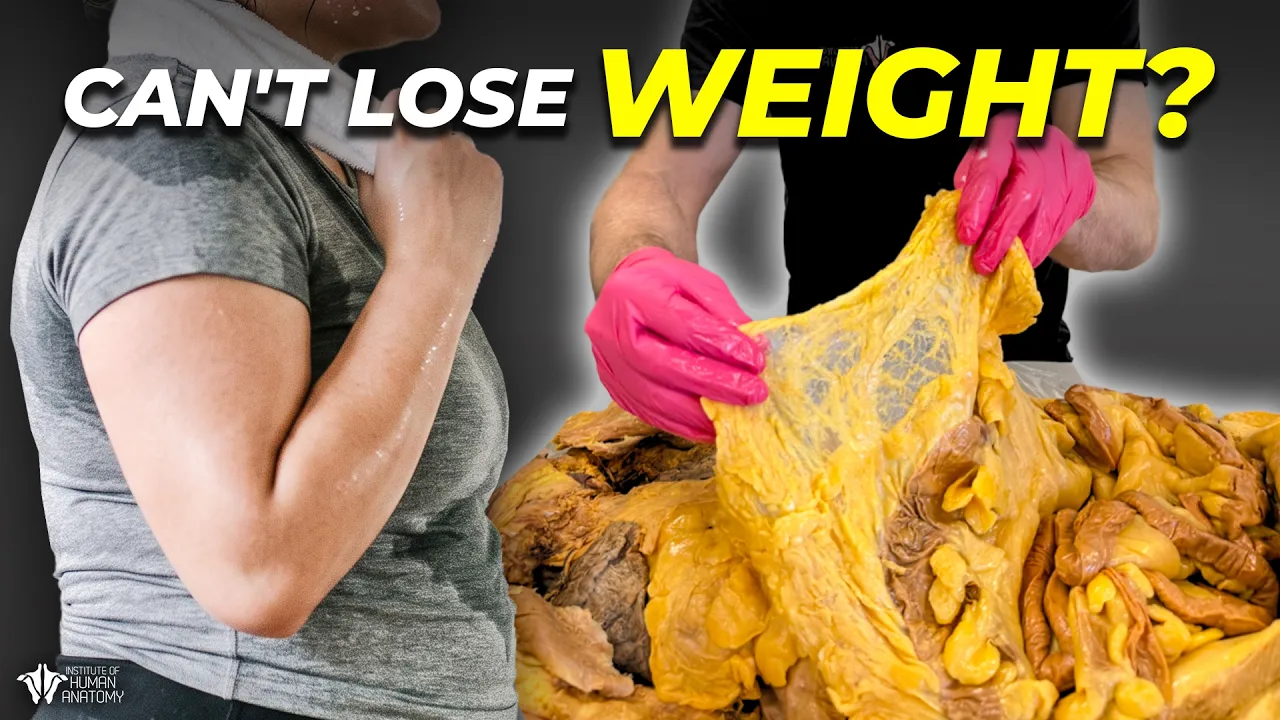
This Is Why You Can’t Lose Weight
 Institute of Human Anatomy
Oct 11, 2026 14:01
Create an account to hide videos, mark them watched, or save them to Don't Miss.
Create an account to hide videos, mark them watched, or save them to Don't Miss.
Create an account to hide videos, mark them watched, or save them to Don't Miss.
Chapters
👉 Download the CalAI app and use promo code "CALIOHA" for a 3-day free trial: https://bit.ly/4gTyTTV
-----
*Follow Us!*
https://beacons.ai/instituteofhumananatomy
🧠 * Ask AI Jonathan!*
https://www.instituteofhumananatomy.com/jonathan-ai
----
In this video, Jonathan from the Institute of Human Anatomy breaks down the real physiology and anatomy behind fat loss, exploring why losing weight is far more complex than just "eating less and moving more".
Using anatomical models, lab specimens, and physiological data, we’ll examine adipose tissue (both subcutaneous and visceral fat), how it stores energy, and how it releases key hormones that talk directly to your brain. You’ll learn how the hypothalamus regulates hunger and metabolism, how leptin resistance and ghrelin impact your appetite during a calorie deficit, and what GLP-1 (and medications like Ozempic) actually does to satiety. We’ll also cover Total Daily Energy Expenditure (TDEE), Resting Metabolic Rate (RMR), Non-Exercise Activity Thermogenesis (NEAT), and why metabolic adaptation slows down calorie burn as you lose weight. Finally, we share evidence-based strategies to optimize satiety, maintain muscle mass, and sustainably manage your weight.
----
📌 Table of Contents
----
❓ Common Questions (FAQs)
Why do I feel so much hungrier as I start losing body fat?
When you lose adipose tissue, your body produces less leptin, signaling to the hypothalamus that energy stores are decreasing. Simultaneously, levels of the hunger hormone ghrelin can rise, driving up your appetite as an evolutionary survival mechanism.
Does building muscle significantly boost your resting metabolic rate?
Skeletal muscle is more metabolically active than adipose tissue, but a pound of muscle only burns roughly 6 calories per day at rest—not 50 calories, as common myths suggest. While gaining muscle has many health benefits, it won't instantly transform your body into a high-powered furnace on its own.
What is NEAT and why does it drop during a calorie deficit?
Non-Exercise Activity Thermogenesis (NEAT) includes all physical movement that isn't formal exercise, such as walking, fidgeting, and standing. During a calorie deficit, your body often subconsciously reduces NEAT to conserve energy, lowering your total daily calorie burn without you realizing it
---
#weightloss #metabolism #anatomyeducation #fatlossscience #hormones #physiology
---
Music: https://www.bensound.com
License code: AUXISEQ0BQAQRBBW
Education
#Institute of Human Anatomy
#IOHA
#Jonathan Bennion
#weight loss physiology
#how fat loss works
#calorie deficit explained
#leptin and ghrelin
#metabolism institute of human anatomy
#jonathan institute of human anatomy
#adipose tissue
#visceral vs subcutaneous fat
#resting metabolic rate
#NEAT energy expenditure
#metabolic adaptation
#GLP 1 and satiety
#how calories in calories out works
#science of hunger and weight loss