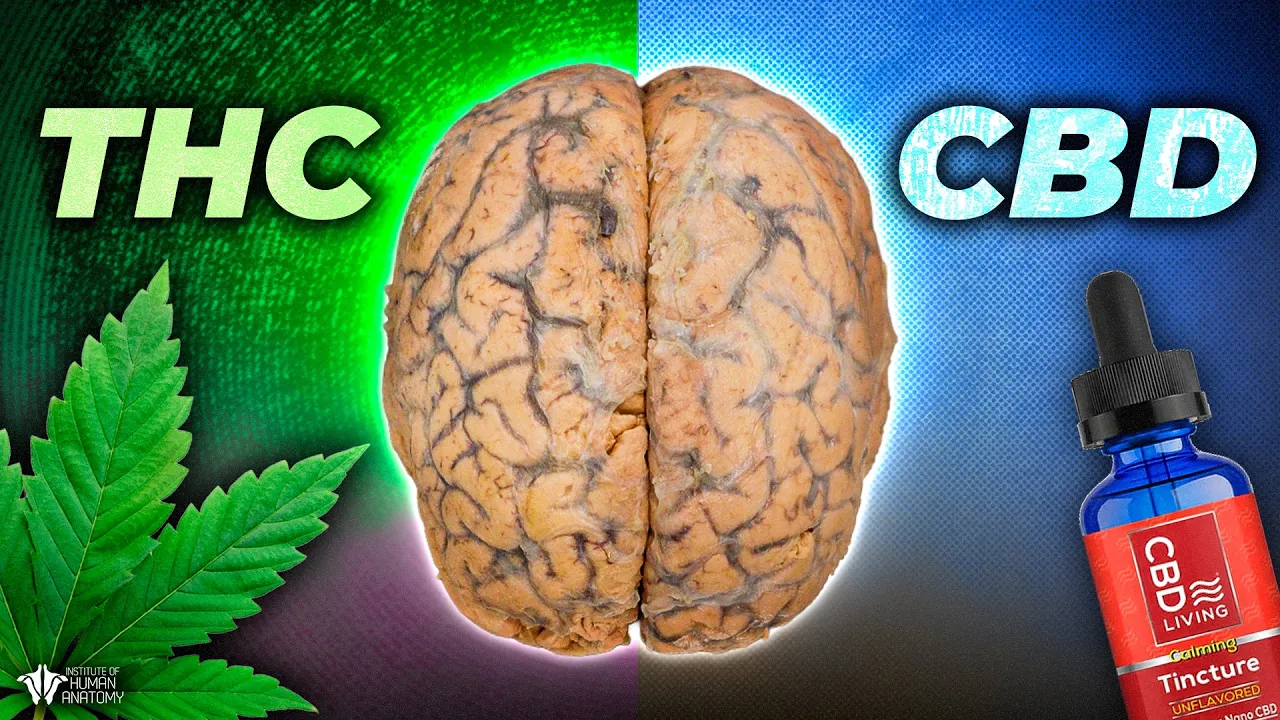
What THC and CBD Actually Does Inside YOUR Brain
 Institute of Human Anatomy
Aug 30, 2026 14:00
Create an account to hide videos, mark them watched, or save them to Don't Miss.
Create an account to hide videos, mark them watched, or save them to Don't Miss.
Create an account to hide videos, mark them watched, or save them to Don't Miss.
Chapters
Join the first group using Clarity by IOHA: https://ioha.app
-----
*Follow Us!*
https://beacons.ai/instituteofhumananatomy
🧠 * Ask AI Jonathan!*
https://www.instituteofhumananatomy.com/jonathan-ai
----
In this video, Jonathan from the Institute of Human Anatomy compares THC and CBD, breaking down their internal physiological mechanisms, brain interactions, and real-world medical effects. Over 100 cannabinoids exist within the cannabis plant, but tetrahydrocannabinol (THC) and cannabidiol (CBD) remain the two most abundant and heavily studied. While chemically similar, their distinct pathways through the human body lead to vastly different physical outcomes.
We take a deep dive into the endocannabinoid system, exploring CB1 receptors across the central nervous system and CB2 receptors throughout immune tissues. Discover how THC directly activates CB1 receptors in the prefrontal cortex, hippocampus, cerebellum, and hypothalamus to produce its characteristic high, memory alterations, coordination changes, and increased appetite. In contrast, see why CBD binds weakly to these receptors, acting as a non-intoxicating compound with proven medical applications like epilepsy treatment—while separating marketing claims from clinical evidence regarding anxiety, sleep, pain, and inflammation.
----
Table of Contents
---
Music: https://www.bensound.com
License code: AUXISEQ0BQAQRBBW
--
Common Questions:
Does CBD get you high like THC? – No. CBD binds very weakly to CB1 receptors in the brain, meaning it is non-intoxicating and does not produce the characteristic high associated with THC.
What is the endocannabinoid system? – It is an internal cell-signaling network made of naturally produced endocannabinoids, CB1 and CB2 receptors, and enzymes that help regulate mood, pain, memory, sleep, and immune function.
What are the proven medical uses of CBD? – The strongest scientific evidence supports CBD for treating certain rare forms of severe epilepsy, while evidence for anxiety, sleep, and chronic pain remains promising but mixed.
--
#thcc #cbd #cannabisscience #humananatomy #brainanatomy #endocannabinoidsystem
Education
#Institute of Human Anatomy
#IOHA
#Jonathan Bennion