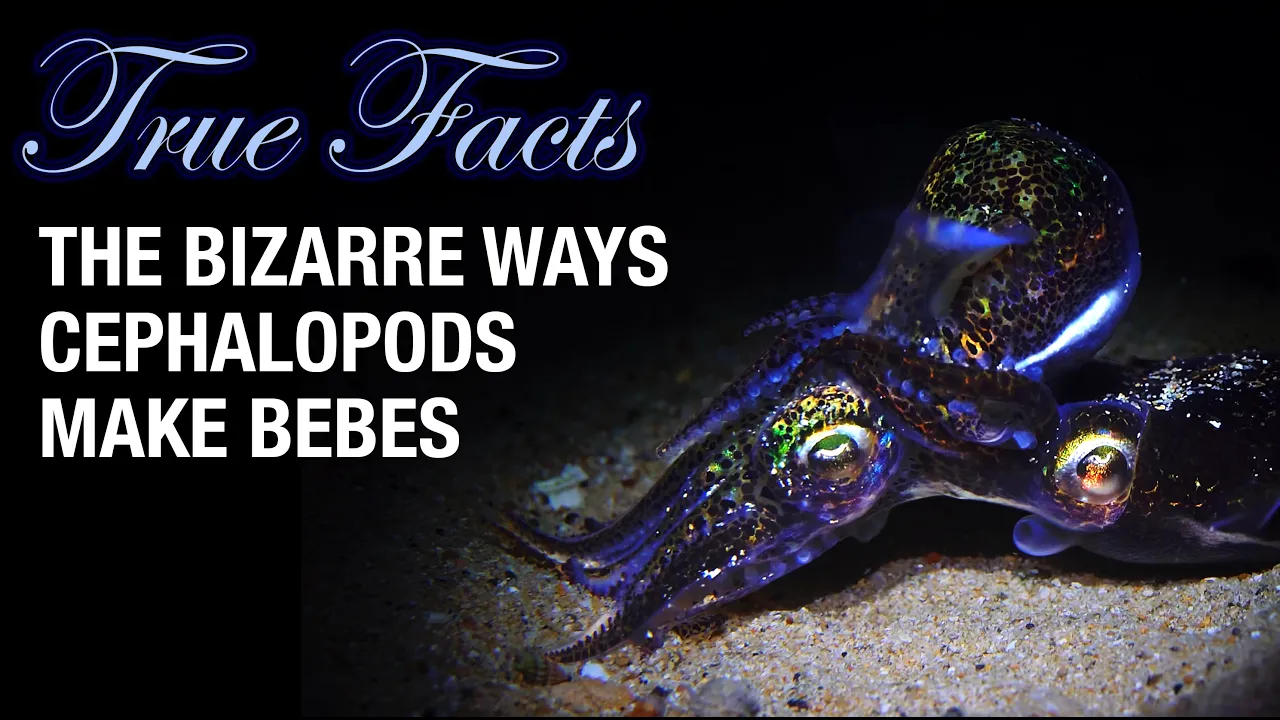
True Facts: The Bizarre Ways Cephalopods Make Bebes
 Ze Frank
Oct 21, 2026 04:00
Create an account to hide videos, mark them watched, or save them to Don't Miss.
Create an account to hide videos, mark them watched, or save them to Don't Miss.
Create an account to hide videos, mark them watched, or save them to Don't Miss.
Join me at https://www.patreon.com/truefacts/
Merch: https://ze-true-store.myshopify.com/
TF Educational channel: @truefactseducational9288
Apostólico, L.H., Marian, J.E.A.R. Dimorphic male squid show differential gonadal and ejaculate expenditure. Hydrobiologia 808, 5–22 (2018). https://doi.org/10.1007/s10750-017-3145-z
Apostólico LH, Marian JEAR. Getting a grip on the squid hectocotylus: Sexually dimorphic glandular system underlies spermatophore transfer in Doryteuthis pleii. Zoology (Jena, Germany). 2026 Mar;175:126328. DOI: 10.1016/j.zool.2026.126328. PMID: 41855842.
Arkhipkin, A., & Laptikhovsky, V. (2010). Observation of penis elongation in Onykia ingens. Journal of Molluscan Studies, 76(3), 299–300. https://doi.org/10.1093/mollus/eyq019
Battaglia, P. et al. (2021). When nature continues to surprise: observations of the hectocotylus of Argonauta argo. The European Zoological Journal, 88(1), 980–986. https://doi.org/10.1080/24750263.2021.1970260
Cuccu, Danila et al. (2013). Development of sexual organs and fecundity in Octopus vulgaris Cuvier, 1797 from the Sardinian waters. Mediterranean Marine Science. 14. 270. 10.12681/mms.412.
García-Flores, M.et al. (2019). Morphological and histological description of the reproductive system of Octopus hubbsorum . Invertebrate Reproduction & Development, 63(4), 268–281. https://doi.org/10.1080/07924259.2019.1646674
Hall, K.C., & Hanlon, R.T. (2002). Principal features of the mating system of a large spawning aggregation of the giant Australian cuttlefish Sepiaapama (Mollusca: Cephalopoda). Marine Biology, 140, 533-545.
Huffard, C. L., & Bartick, M. (2015). Wild Wunderpus photogenicus and Octopus cyanea employ asphyxiating ‘constricting’ in interactions with other octopuses. Molluscan Research, 35(1), 12–16. https://doi.org/10.1080/13235818.2014.909558
Iwata Y, et al. How female squid inseminate their eggs with stored sperm. Curr Biol. 2019 Jan 21;29(2):R48-R49. doi: 10.1016/j.cub.2018.12.010. PMID: 30668945.
Morse P and Huffard CL (2019) Tactical Tentacles: New Insights on the Processes of Sexual Selection Among the Cephalopoda. Front. Physiol. 10:1035. doi: 10.3389/fphys.2019.01035
Ibáñez CM et al. (2019) Sexual Selection and the Evolution of Male Reproductive Traits in Benthic Octopuses. Front. Physiol. 10:1238. doi: 10.3389/fphys.2019.01238
López Galán A. et al. (2020) Dynamic Courtship Signals and Mate Preferences in Sepia plangon. Front. Physiol. 11:845. doi: 10.3389/fphys.2020.00845
Marian JE. Spermatophoric reaction reappraised: novel insights into the functioning of the loliginid spermatophore based on Doryteuthis plei. J Morphol. 2012 Mar;273(3):248-78. doi: 10.1002/jmor.11020. Epub 2011 Sep 28. PMID: 21956428.
Nakayama A. et al. Ritualized ink use during visual courtship display by males of the sexually dimorphic cuttlefish Sepia andreana. Ecol Evol. 2024 Feb 2;14(2):e10852. doi: 10.1002/ece3.10852. PMID: 38314312; PMCID: PMC10835506.
Noriyosi Sato et al. High-speed camera observations of copulatory behaviour in Idiosepius paradoxus: function of the dimorphic hectocotyli, Journal of Molluscan Studies, Volume 79, Issue 2, May 2013, Pages 183–186, https://doi.org/10.1093/mollus/eyt005
Sato N, Kasugai T, Munehara H. Spermatangium formation and sperm discharge in the Japanese pygmy squid Idiosepius paradoxus. Zoology (Jena). 2014 Jun;117(3):192-9. doi: 10.1016/j.zool.2014.02.001. Epub 2014 Apr 18. PMID: 24813852.
Sato, Noriyosi et al. “Sperm transfer or spermatangia removal: postcopulatory behaviour of picking up spermatangium by female Japanese pygmy squid.” Marine Biology 160 (2012): 553 - 561.
Schnell, A.K. et al. Female receptivity, mating history, and familiarity influence the mating behavior of cuttlefish. Behav Ecol Sociobiol 69, 283–292 (2015). https://doi.org/10.1007/s00265-014-1841-5
So Ryung Shin, Jung Jun Park, Jung Sick Lee. Spermatophore formation in Todarodes pacificus, Tissue and Cell, Volume 104, Part 2,2027,103985, ISSN 0040-8166, https://doi.org/10.1016/j.tice.2026.103985.
Villar P. S. et al. ,A sensory system for mating in octopus.Science392,96-101(2026).DOI:10.1126/science.aec9652
Vlasova, E.V., Sabirov, R.M., Golikov, A.V. Reproductive Biology of the Golden Cuttlefish Sepia esculenta (Cephalopoda, Sepiida). Diversity 2023, 15, 455. https://doi.org/10.3390/d15030455
Wada, T., Takegaki, T., Mori, T. et al. Sperm displacement behavior of the cuttlefish Sepia esculenta (Cephalopoda: Sepiidae). J Ethol 23, 85–92 (2005). https://doi.org/10.1007/s10164-005-0146-6
Wodinsky, J. Reversal and transfer of spermatophores by Octopus vulgaris and O. hummelincki . Mar Biol 155, 91–103 (2008). https://doi.org/10.1007/s00227-008-1010-3
Yamamoto, J., Adachi, K., Bower, J.R. et al. Close-up observations on the spawning behavior of a captive Japanese flying squid (Todarodes pacificus). Sci Rep 9, 19739 (2019). https://doi.org/10.1038/s41598-019-56071-0
Pets & Animals