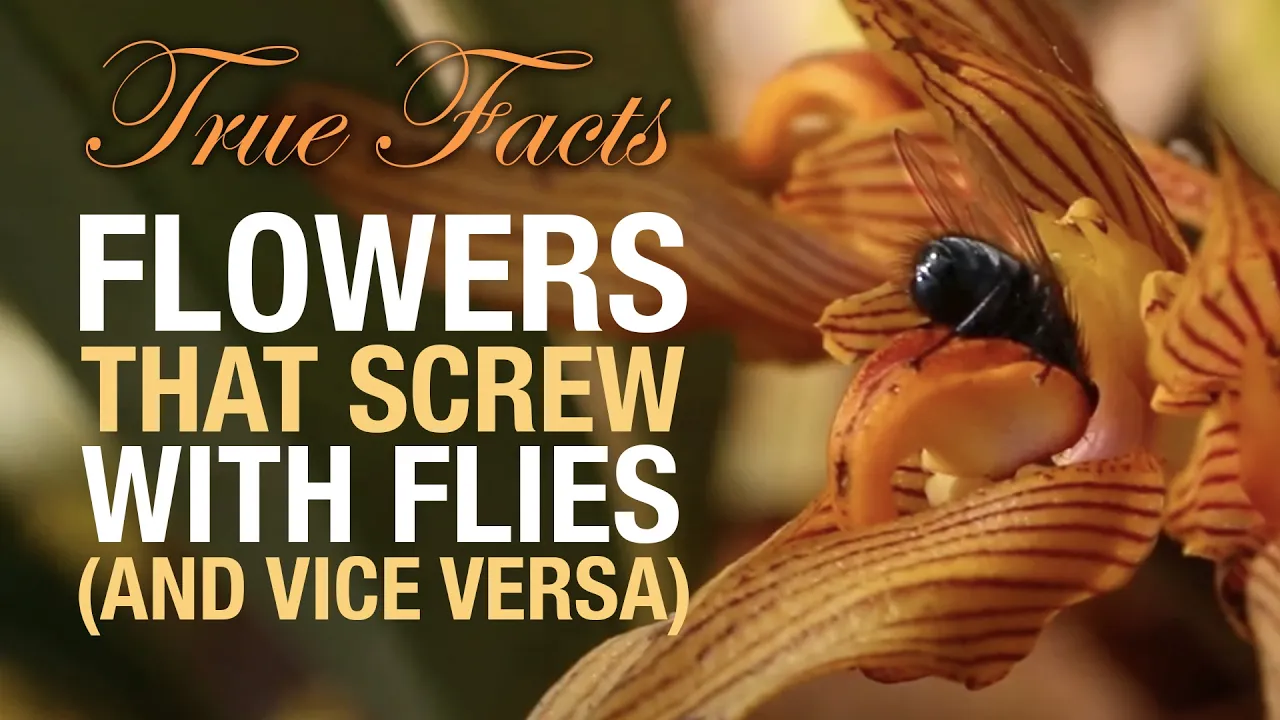
True Facts: Flowers That Screw Flies
 Ze Frank
Aug 12, 2026 14:30
Create an account to hide videos, mark them watched, or save them to Don't Miss.
Create an account to hide videos, mark them watched, or save them to Don't Miss.
Create an account to hide videos, mark them watched, or save them to Don't Miss.
Join me at https://www.patreon.com/truefacts
Merch: https://ze-true-store.myshopify.com/
TF Educational channel: @truefactseducational9288
Thank you Dr. Steven Johnson, Bruce Anderson, Dr. Timotheüs Van der Niet.
Citations:
Bjçrn Bohman et al. 2017. The Spider Orchid Caladenia crebra Produces Sulfurous Pheromone Mimics to Attract its Male Wasp Pollinator. Angew. Chem. Int. Ed. 2017, 56, 8455 –845.
https://doi.org/10.1002/anie.201702864
Herbert Braunschmid et al. 2017. Interpopulation variation in pollinators and floral scent of the lady’s-slipper orchid Cypripedium calceolus L. Arthropod-Plant Interactions (2017) 11:363–379.
https://doi.org/10.1007/s11829-017-9512-x
João C. F. Cardoso et al. 2023. The lady’s ‘slippery’ orchid: functions of the floral trap and aphid mimicry in a hoverfly-pollinated Phragmipedium species in Brazil. Annals of Botany 131: 275–286.
https://doi.org/10.1093/aob/mcac140
Karen Gil-Amaya et al. 2026. Pollination ecology of Dracula erythrochaete (Orchidaceae): brood-site imitation or food deception? Botanical Journal of the Linnean Society, 2025, 207, 279–297.
https://doi.org/10.1093/botlinnean/boae054
Tobias Hayashiet et al. 2022. Sexual deception of male Bradysia (Diptera: Sciaridae) by floral odour and morphological cues in Pterostylis (Orchidaceae.) Botanical Journal of the Linnean Society, 2022, 200, 433–449.
https://doi.org/10.1093/botlinnean/boac015
Annemarie Heiduk et al. 2023. ‘Bleeding’ flowers of Ceropegia gerrardii (Apocynaceae-
Asclepiadoideae) mimic wounded insects to attract
kleptoparasitic fly pollinators. New Phytologist (2023) 239: 1490–1504
https://doi.org/10.1111/nph.18888
Hong Jianget et al. 2020. Cypripedium subtropicum (Orchidaceae) employs aphid colony mimicry to attract hoverfly (Syrphidae) pollinators.New Phytologist (2020) 227: 1213–1221
https://doi.org/10.1111/nph.16623
Johnson, S. D. et al. 2026. Pollination by
long‐proboscid horseflies and its implications for reproductive isolation among coflowering Satyrium orchids in South Africa. American Journal of Botany 113(6): e70221.
https://doi.org/10.1002/ajb2.70221
Kellenberger et al., 2023. Multiple gene co-options underlie the rapid evolution of sexually deceptive flowers in Gorteria diffusa. Current Biology 33, 1502–1512
https://doi.org/10.1016/j.cub.2023.03.003
Aroonrat Kidyoo et al. 2022. Pollinator and floral odor specificity
among four synchronopatric species of Ceropegia (Apocynaceae)
suggests ethological isolation that prevents reproductive interference. Nature Scientific Reports 12:13788
https://doi.org/10.1038/s41598-022-18031-z
Giorgio C. Lombardia et al. 2021. Pollination biology of Erica aristata: First confirmation of long-proboscis fly-pollination in the Ericaceae. South African Journal of Botany.
https://doi.org/10.1016/j.sajb.2021.07.007
Florent Martos et al. 2015. Chemical and morphological filters in a specialized floral mimicry system. New Phytologist (2015) 207: 225–234.
https://doi.org/10.1111/nph.13350
Carlos A. Matallana-Puerto et al. 2024. Sex, flies and flower trap: Trapping trichomes and their function in pollination. Functional Ecology. 2024;38:2261–2270.
https://besjournals.onlinelibrary.wiley.com/doi/10.1111/1365-2435.14633
Galilea Orellana‑Vera et al. 2025. Experimental evidence of pollination by deception in a dioecious palm. BMC Ecology and Evolution (2025) 25:46
https://doi.org/10.1186/s12862-025-02388-6
Ana Ospina-M et al. 2024. The sweet path of Hansel and Gretel: pollination system of Masdevallia hortensis (Orchidaceae: Pleurothallidinae) in a cloud montane forest of the Cordillera Occidental, in Colombia. Plant Systematics and Evolution (2024) 310:43.
https://doi.org/10.1007/s00606-024-01924-z
D. Rakosy et al. 2017. Looks matter: changes in flower form affect pollination effectiveness in a sexually deceptive orchid. J. Evol. Biol. 30 (2017) 1978-1993.
https://doi.org/10.1111/jeb.13153
Anna Vlasankova et al. 2017. The nectar spur is not only a simple specialization for long-proboscid pollinators. New Phytologist (2017) 215: 1574–1581.
https://nph.onlinelibrary.wiley.com/doi/10.1111/nph.14677
Zhang, S. et al. (2024). Floral mechanisms promote pollination success and reduce the incidence of self- pollination in a fly- pollinated self- incompatible orchid. Ecology and Evolution, 14, e11295.
https://doi.org/10.1002/ece3.11295
Pets & Animals