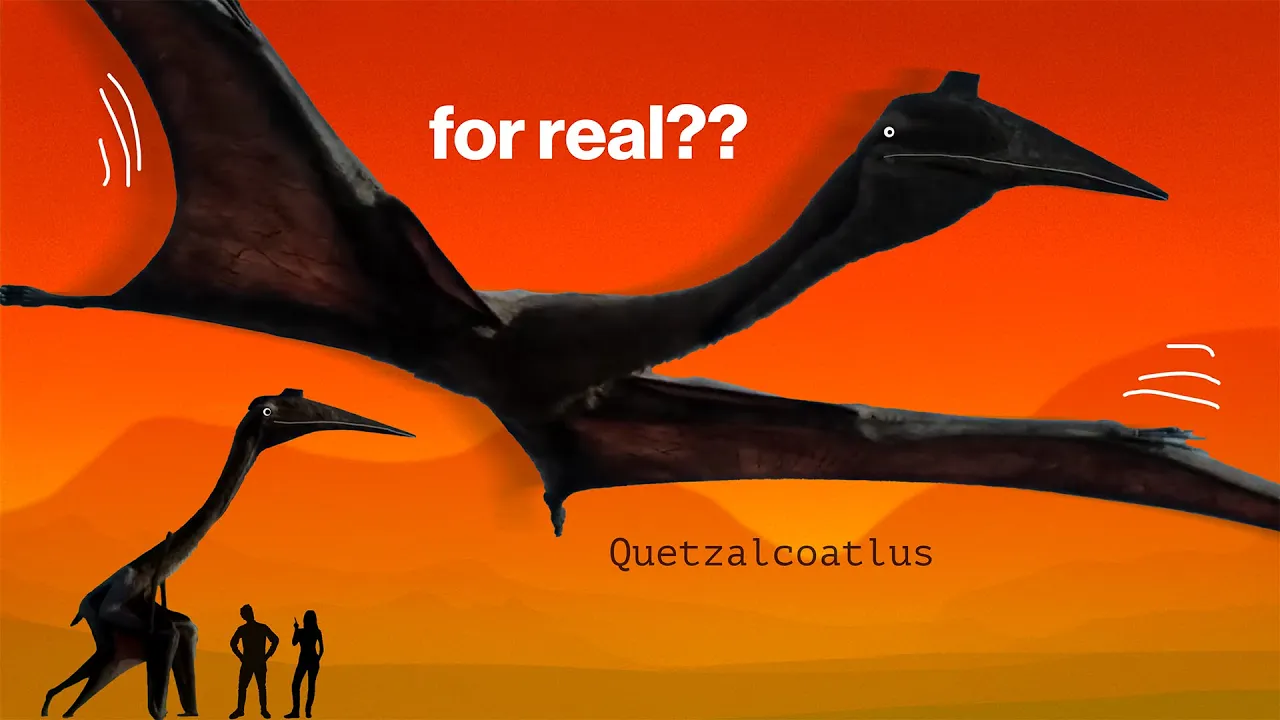
What Quetzalcoatlus was really like
 Howtown
Jun 26, 2025 14:35
Create an account to hide videos, mark them watched, or save them to Don't Miss.
Create an account to hide videos, mark them watched, or save them to Don't Miss.
Create an account to hide videos, mark them watched, or save them to Don't Miss.
Chapters
Thanks to Storyblocks for sponsoring this video! Download unlimited stock media at one set price with Storyblocks: https://storyblocks.com/howtown
To support independent science journalism
JOIN OUR PATREON: https://www.patreon.com/Howtown
TikTok: https://www.tiktok.com/@howtown_
Instagram: https://www.instagram.com/howtown_videos/
This video was supported by the Alfred P. Sloan Foundation, in association with IMI.
https://sloan.org/
https://www.theimi.co/
Sources and further reading: https://docs.google.com/document/d/1Umv9tV7Ja-sy8gFUVEeTO0tLjGsDq0KpNrlLcKyTJ6Y
Corrections: The righthand clip at is mislabelled as Dinosaur Planet, this clip is from Prehistoric Planet. At we misspelled "Natural History Museum of Los Angeles County"
Thank you to Lexi McQueen! https://bsky.app/profile/blackgirlmage.bsky.social https://x.com/blackgirlmage
And to Mark Witton for the illustrations https://www.patreon.com/markwitton
We're grateful for the generous support of the Patreon Town Council:
Bev Fong
Chris Wubbels
Sean Barrett
Mike Purvis
Jon Hewett
Albychen
Hernando Garcia
Sean Talon
Evan Hass
Mark Tinker
Julian Mayorga
L.A. O’Connor
Marcos Huerta
Joaquim Salles
Sam Gaty
Jason Dunlap
Parag Mallick
Edgar Sutawika
Richard Gladas
Tim Davey
Navneet
Tra Him
Taylor
Pedro ZM
Ale
Martin Weeks
Dimi
Bryce Golden-Chen
Estelle Caswell
Yashaswi Narasimha
martin david
Marc Hermes
Matthew Stvartak
Garret Wates
Slightly Suspicious Mind
Kellyn Lorentzen-Goler
omg.science
Duncan Stannett
Keith England
Aaron Wesson
TikTok: https://www.tiktok.com/@howtown_
Insta: https://www.instagram.com/howtown_videos/
Quetzalcoatlus, one of the largest known flying animals, survives in science as sixteen wing bones pulled from Cretaceous Big Bend by grad student Doug Lawson in 1971. Paleontologists reverse-engineer the rest of its body by referencing its Azhdarchid cousins like Zhejiangopterus, and Q. lawsoni, making inferences from extant archosaurs like birds and alligators, examining trackways, and modeling their wings in flight software. Still, there's a lot that they don't know about how these giant pterosaurs lived. Thin bone walls, rare 3-D preservation, and million-to-one erosion odds explain why cousins Hatzegopteryx, Arambourgiania, Cryodrakon, and Thanatosdrakon remain fragmentary in the fossil record. The sparse clues they left behind have inspired a wide range of depictions in documentaries over the years, the pinnacle of which was Prehistoric Planet from the BBC's Natural History team.
Chapters:
Science & Technology