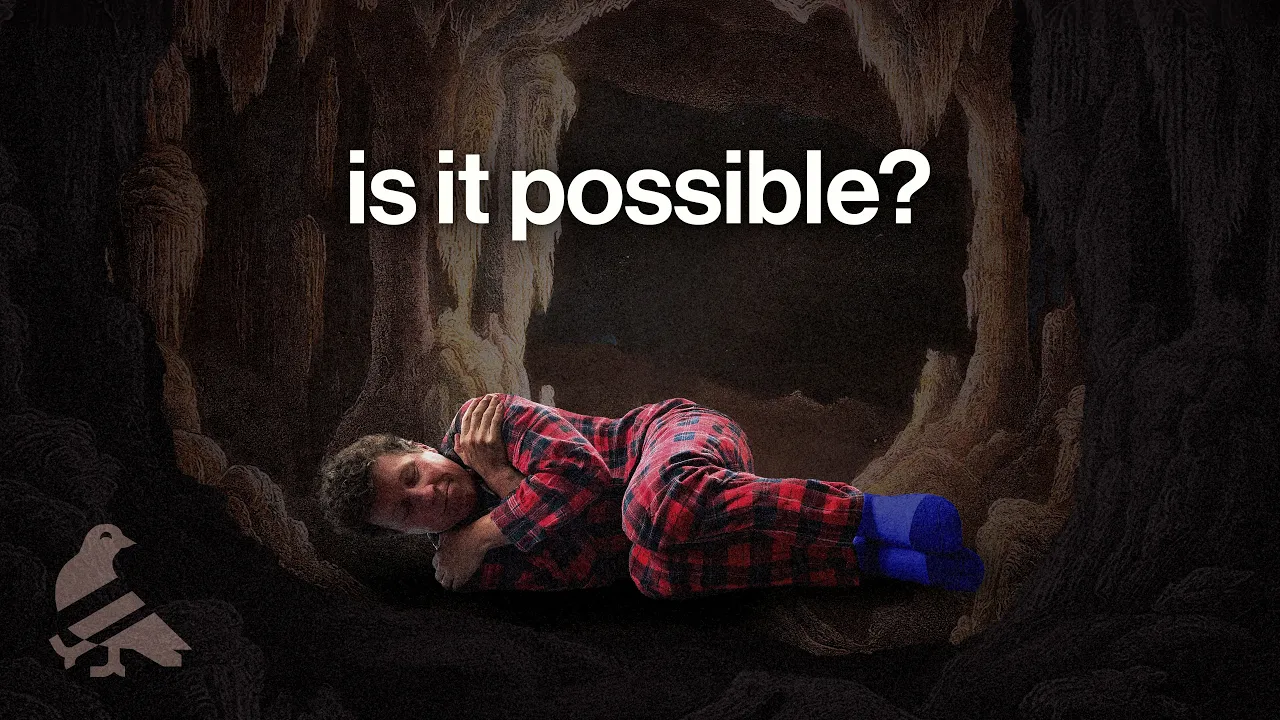
Triggering hibernation in humans
 Howtown
Sep 4, 2026 13:00
Create an account to hide videos, mark them watched, or save them to Don't Miss.
Create an account to hide videos, mark them watched, or save them to Don't Miss.
Create an account to hide videos, mark them watched, or save them to Don't Miss.
Chapters
Visit https://hensonshaving.com/howtown or use code 'howtown' to receive 100 free blades with the purchase of a razor. (Ensure both products are in the cart for the code to take effect.)
Our sources: https://docs.google.com/document/d/1V0cDREzpawQ72LVELtY1nVDew8KVWIUzvsMlLVLLAEg/edit?usp=sharing
To support independent science journalism and get bonus content ...
JOIN OUR PATREON: https://www.patreon.com/Howtown
Instagram: https://www.instagram.com/howtown_videos
TikTok: https://www.tiktok.com/@howtown_
We are so thankful for the generous people who support this channel through our Patreon Town Council:
Bev Fong
Sean Barrett
Albychen
avaren
Evan Hass
Mark Tinker
L.A. O’Connor
Marcos Huerta
Joaquim Salles
Sam Gaty
Edgar Sutawika
Navneet
Pedro ZM
MW
Dimi
Bryce Golden-Chen
Estelle Caswell
Gregory Laborde
Yash Murthy
Christopher Asplund
Matthew Stvartak
Slightly Suspicious Mind
Kellyn Lorentzen-Goler
omg.science
Duncan Stannett
Keith England
Jocelyn Tabancay Duffy
Casey Schatz
Mark McCreary
Jonathan McCabe
Branden Ushjima
Dr Esh | Second Opinion
Wookiee Henderson
Byung-Cheol Cho
Frances Haugen
Gilbo Jiménez
Roy Lara
Melanie Halley
Dmitry
Archie Stonehill
Ed Martini
Jamieson Urquhart
Nate Hingst
Jay McZara
Scott Heimendinger
Thin Air
Noëmie
Gregory Batson
Ritvik
Mrglenna
Deborah Clark
Larry Fizz
Michael Thomas
Jamie
Thi Ha Phuong Dao
Bobby
hoang tung tran nguyen
WhateverReason
Mickey Snell
Michael
Hope Morton
Bryce Schuebert
Sarah Espedido
Ad-read music:
"Dover" by The Westerlies
Chapters:
Can humans hibernate? This episode investigates the science of human hibernation, induced torpor and suspended animation -- from the brain circuits that regulate metabolism and body temperature to experiments exploring how doctors might safely induce a hibernation-like state in humans.
Drawing on research into Arctic ground squirrels, edible dormice, bears, hamsters, mice and rats, we examine how natural hibernation suppresses metabolism, heart rate, breathing and body temperature; how neurons in the hypothalamus and preoptic area may act as a “torpor switch”; and how scientists induce synthetic torpor in animals. Researchers Nick Clark, Sinisa Hrvatin, Domenico Tupone, Ryan Sprenger and Kate Flickinger guide us through the evidence, including ultrasound-induced torpor, thermoregulatory inversion and University of Pittsburgh human experiments using dexmedetomidine and surface cooling.
Then we ask what human torpor might actually be good for: buying time after a heart attack or stroke, reducing ischemia-reperfusion injury, preserving donor organs, and informing research on diabetes, cancer, dementia, Alzheimer’s disease, aging and longevity. We also investigate human hibernation for deep-space travel: whether torpor could reduce food and oxygen needs on a Mars mission and protect astronauts from space radiation, muscle atrophy, bone loss, blood clots, microgravity and psychological strain. Finally, we look at NASA’s proposed STASH hibernation laboratory, which could send Arctic ground squirrels to the International Space Station ... and ask how close human hibernation really is.
Science & Technology