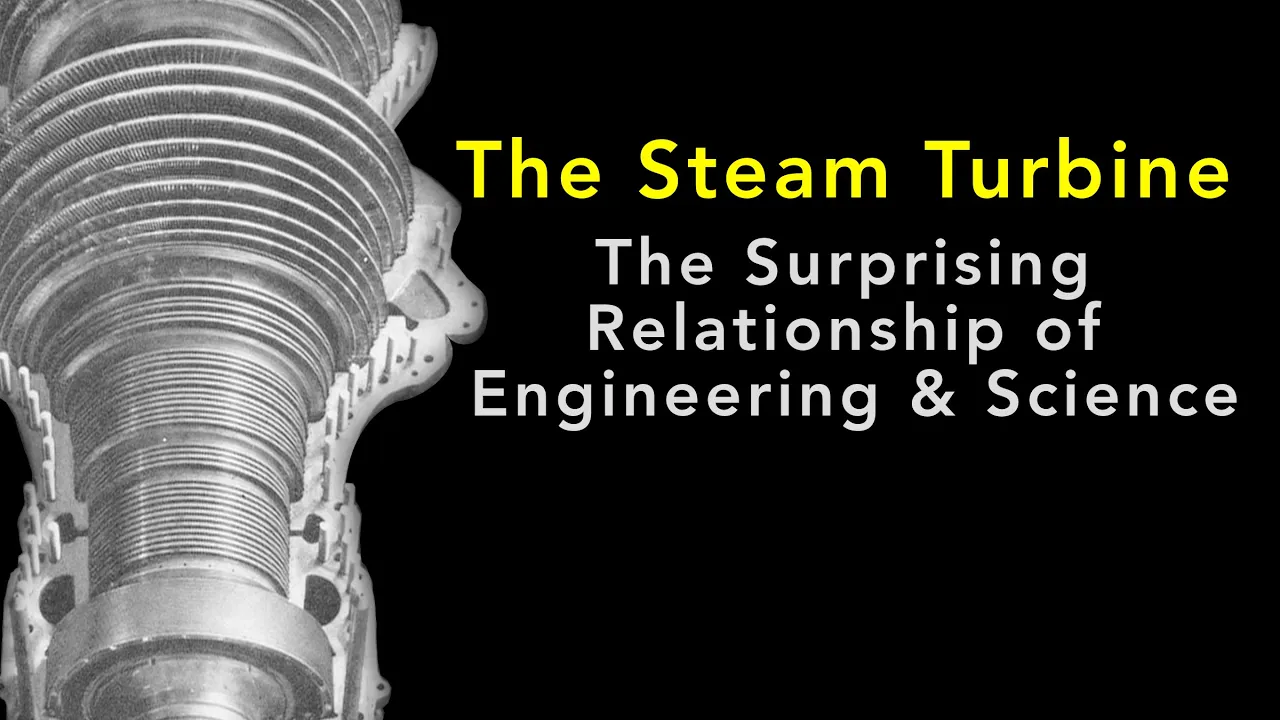
The Steam Turbine: The Surprising Relationship of Engineering & Science
 engineerguy
May 11, 2023 11:00
Create an account to hide videos, mark them watched, or save them to Don't Miss.
Create an account to hide videos, mark them watched, or save them to Don't Miss.
Create an account to hide videos, mark them watched, or save them to Don't Miss.
Chapters
Charles Parsons designed a superior steam engine called a turbine, but was ignored until he crashed a celebration of Queen Victoria's Diamond Jubilee. His turbine still generates most electricity.
*Other videos in this series*
_Episode 1:_ Building a Cathedral without Science or Mathematics: The Engineering Method Explained https://youtu.be/_ivqWN4L3zU
_Episode 2:_ Controlling Turbulence and Evolution: How Engineers Overcome Uncertainty forthcoming https://youtu.be/9RAMqFg7laE
_Episode 4:_ The Microwave Oven Magnetron: What an Engineer Means by “Best” https://youtu.be/p8IO9u9IuOs
*Video Summary*
To understand the relationship between engineering and science, Bill notes he will share in this video the story of how an engineer created a revolutionary engine by taming the extraordinary power of steam.
Bill explains that steam can power engines because it expands: one cup of liquid water will expand into 1,600 cups of steam.
Bill explains that this dramatic change of volume exerts a force that engineers tapped into in the early eighteenth century to drive reciprocating steam engines. He explains the operation of such an engine, focusing on the piston/cylinder where steam expands and the levers that translate the back and forth motion (reciprocating) of the piston to rotating motion.
Bill notes that while the reciprocating steam engine revolutionized the world, it wasted much of the steam’s energy. Once the steam has expanded to about sixteen times its original volume it lacks the “oomph,” the force, to overcome the friction of the heavy piston within the walls of the cylinder. And friction in the arms that convert reciprocating motion into circular motion chew up some of the steam’s energy.
But, in the late nineteenth century a novel steam engine appeared that used the energy from an expansion of an astonishing four hundred and seventy nine times a cup of water’s volume. That novel engine was perfected by Charles Parsons. While a huge leap forward, no one would buy his engine.
In frustration Parsons built a ship called the _Turbinia_ to convince everyone of the superiority of his engine. To attract attention he crashed a naval display honoring Queen Victoria’s Diamond Jubilee in 1897.
Parsons’s engine eliminated the need for the piston and cylinder and levers of the reciprocating engine.
Parsons fused two two ways of using steam to rotate a shaft. The first is the aeolipile, designed by Hero of Alexandria in about 130 BC.
In 1629 an Italian engineer, Giovanni Branca, designed a giant boiler shaped like a human head. From its mouth a jet of expanding steam struck a paddle wheel — much like a water wheel — which turned gearing.
Bill explains how Parsons succeeded by cleverly combining the action of the aeolipile and Branca’s device by placing thirty wheels along a shaft — half rotated with the shaft, half were affixed to the casing.
This design is simple in concept, but Parsons described the execution as of “almost infinite complexity” because of an astronomical number of dimensions and configurations of wheels and blades and every other design variable in his turbine.
What separated Parsons from the thousands of inventors before him was, he said, the “data of the physicists.” Parsons drew on the data of a forgotten French scientist, Henri Victor Regnault, who spent nearly thirty years documenting the properties of steam. From the data tabulated by Regnault, Parsons could determine that _in principle_ a functioning turbine _could_ be built.
For Parsons, scientific knowledge helped rule out what wouldn’t work, narrow the possibilities of what does, and shorten the path to a solution: scientific knowledge was being used as a rule of thumb. Thus the relationship between science and engineering is that science supplies gold-plated rules of thumb.
Although the turbine was a nineteenth century invention, Parsons’s turbine still enables the daily lives of nearly every human on the globe as its descendants generate the world’s electricity.
In the next video Bill explores a single word from this definition of the engineering method: What exactly does an engineer mean by “best.”
Science & Technology