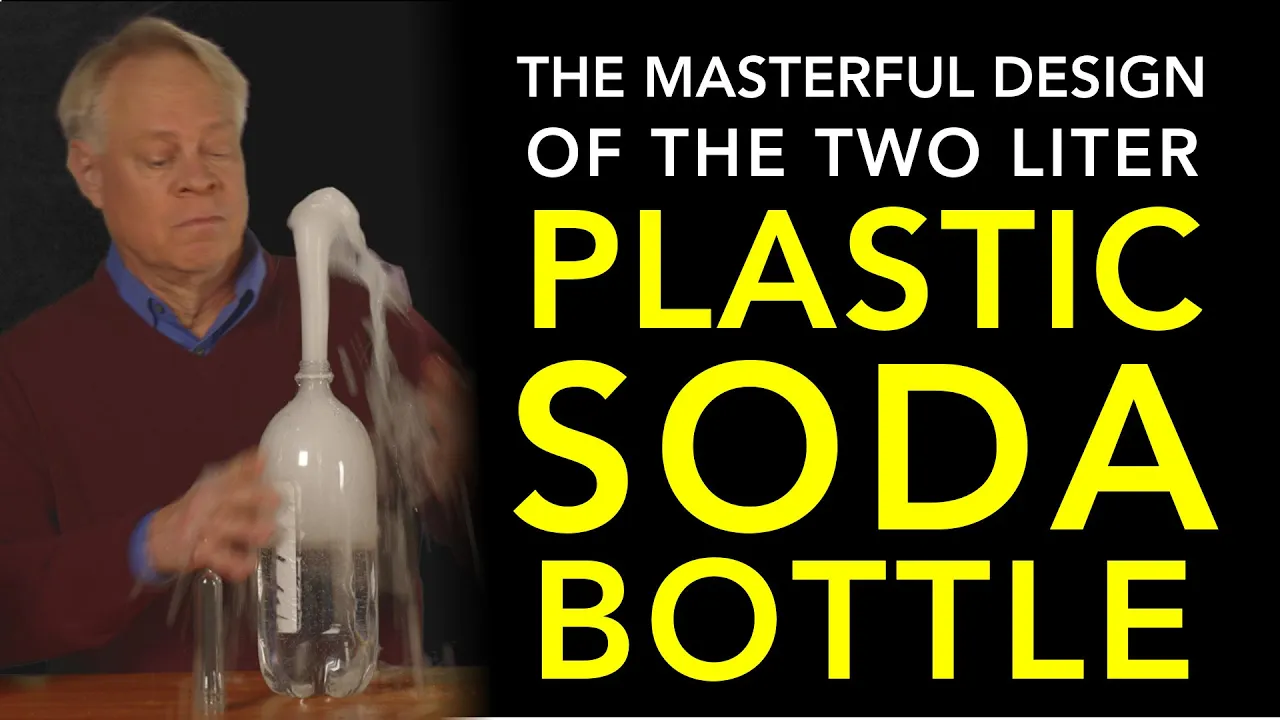
The masterful design of the two-liter plastic soda bottle
 engineerguy
Apr 11, 2025 11:01
Create an account to hide videos, mark them watched, or save them to Don't Miss.
Create an account to hide videos, mark them watched, or save them to Don't Miss.
Create an account to hide videos, mark them watched, or save them to Don't Miss.
Chapters
Bill explains how the two-liter plastic soda bottle begins as a plastic tube, called a preform, which is heated and inflated with air in a bottle-shaped mold. He explains how the stretching of the preform creates a crystalline regions in the bottle's plastic (polyethylene terephthalate) that create a bottle with great strength, low permeability to carbon dioxide, but which is also lightweight—some 35 times lighter than a glass bottle of the same size. Bill explains key features of the bottles design, including: why the bottle looks like it does, why the neck has gaps in its threads, and how the tamper-proof ring works. He also discusses "hot-fill bottles" used for sports drinks and plastic juice bottles, noting the panels molded into the bottles to accommodate temperature changes. Lastly, he discusses briefly the recycling of PET bottles, although noting that about 75% of the 500 billion PET bottles manufactured annually end up in landfills or are incinerated.
_Video summary_
Plastic soda bottles begin as preforms (small tubes) created by injection molding. This preform is heated slightly, then inflated to create a bottle. (See Bill's video on injection molding: https://www.youtube.com/watch?v=RMjtmsr3CqA)
In manufacturing the preform is inflated in a mold in two steps — by a blast of air at 100 PSI initially, then a blast at 580 PSI — to form the bottle in a fraction of a second.
The energy to generate the compressed air is the largest cost after the plastic itself.
A plastic soda bottle is strong enough that it will neither burst nor deform when dropped from two meters onto a concrete floor
The bottle must also be strong to contain the carbon dioxide dissolved in the soda, which exerts a pressure of about 70 psi/4.8 bar.
A plastic soda bottle is made from PET, polyethylene terephthalate. When the bottle is stretched small crystalline regions are formed, which are oriented in the two directions of stretch: along the axial and hoop directions. This orientation of the crystalline regions (about 25% of bottle's wall) increases the strength of the plastic.
The plastic used in a soda bottle is strong enough to keep the carbonation of the soda from distorting it, unlike a plastic milk jug, which is made from a different type of plastic (high density polyethylene).
The stretch induced crystallization reduces carbon dioxide leakage: a 2 liter plastic soda bottle loses 15% of its carbonation in six weeks. Although this isn't as good as a glass bottle, it's good enough.
The bottle has a hemispherical shape at the top so the pressure is distributed evenly on the wall. Bottles from the 1970s had hemispherical bottoms, which were covered with a plastic cap so the bottle could sit on the table.
To get rid of the cap, manufacturers invented a "petaloid" bottom — meaning like a flower. This petaloid bottom provides stability while maintaining strength.
The bottle neck features specific engineering elements: a lip for the mold, a beveled lip for the tamper-proof ring, and discontinuous threads to release pressure. Engineers have reduced the neck size to save plastic (about 2g per bottle).
To engineer a new neck for the bottle engineers used trial and error. They subjected the neck to many tests.
"Hot-fill" bottles are designed for beverages requiring higher fill temperatures. They have special panels to accommodate contraction and expansion.
Patent disputes in the 1990s delayed implementation of the petaloid and hot-fill bottle bottom designs.
Approximately 500 billion PET bottles are manufactured yearly; about 75% end up in landfills or are incinerated. Yet, PET is recyclable and can be converted into fibers for fabrics used in sports jerseys and car upholstery.
Science & Technology