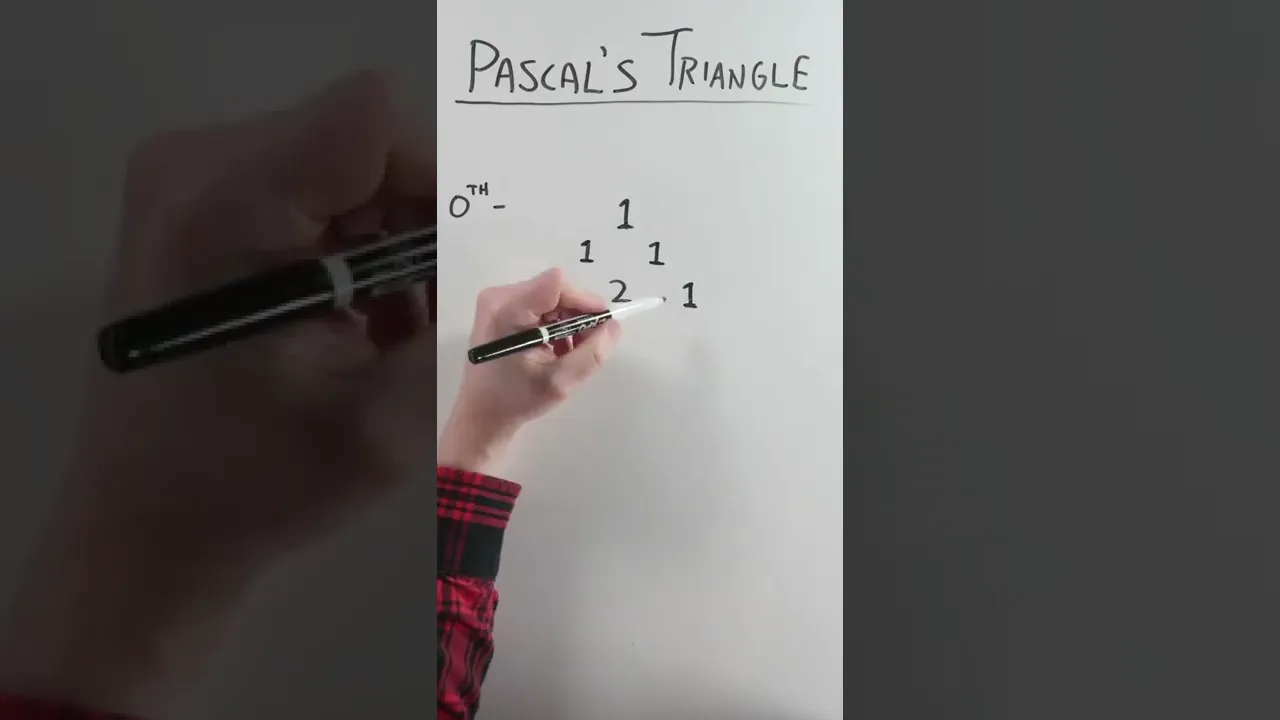
The Tip of Pascal's Iceberg #shorts
 Vsauce2
May 16, 2022 16:07
Create an account to hide videos, mark them watched, or save them to Don't Miss.
Create an account to hide videos, mark them watched, or save them to Don't Miss.
Create an account to hide videos, mark them watched, or save them to Don't Miss.
Blaise Pascal may have published Traité du triangle arithmétique in 1665, but the world knew about his triangle centuries before. Scholars in India, Persia, China, and even Germany played with the possibilities of a pattern of binomial coefficients, but Pascal brought it to the broader world. Pascal’s Triangle is easy to construct by hand; just start with 1 and do the arithmetic.
As Pascal’s Triangle expands, it reveals mathematical patterns we value elsewhere, from the simple whole number line and the primacy of 1 to a succession of the powers of 2 and the digits of 11’s exponential sequence. And lurking within is a classic Fibonacci sequence in which each successive digit is the sum of its two predecessors.
But one of the most interesting elements of Pascal’s Triangle is the way it lays bare the possible outcomes of any series of simple coin flips. Like everything else in Pascal’s Triangle, it’s in there if you know where to look.
#shorts #vsauce #maths
Education
#vsauce2
#vsause
#vsause2
#pascals
#pascals triangle
#blaise pasc
#blaise pascal
#blaise pascal probability theory
#pascals tria
#pascals triangle discrete math
#pascals triangle ted talk
#pascals triangle numberphile
#pascals triangle and binomial expansion
#pascal tria
#pascal triangle
#pascal triangle example
#math history
#triangle math
#triangle maths problems
#probability theory
#pascal prob
#pascal probability theory
#pascal probability
#math shorts
#vsauce2 shorts
#vsauce