The Bad Math Used To Punish Criminals
 Vsauce2
Jun 20, 2022 17:59
Create an account to hide videos, mark them watched, or save them to Don't Miss.
Create an account to hide videos, mark them watched, or save them to Don't Miss.
Create an account to hide videos, mark them watched, or save them to Don't Miss.
Documentaries, television and movies are obsessed with crime. Is the accused actually guilty? If not, who is? If so, will they get away with it? All these questions matter -- but the most important question might be what happens when a criminal is sentenced.
Determining a fair and just sentence for an offender is a delicate balance of punishment, rehabilitation and protection. From Aristotle to restorative justice initiatives, we’ve spent thousands of years developing theories of sentencing and striving for better ways to implement them. But no matter how refined our concept of justice becomes, it’s also subject to overt biases and both conscious and unconscious discrimination based on any number of factors, from age and race to completely unrelated societal forces. Does that mean real justice is impossible? And can we combat the failings of the human mind by replacing people with mandated algorithms?
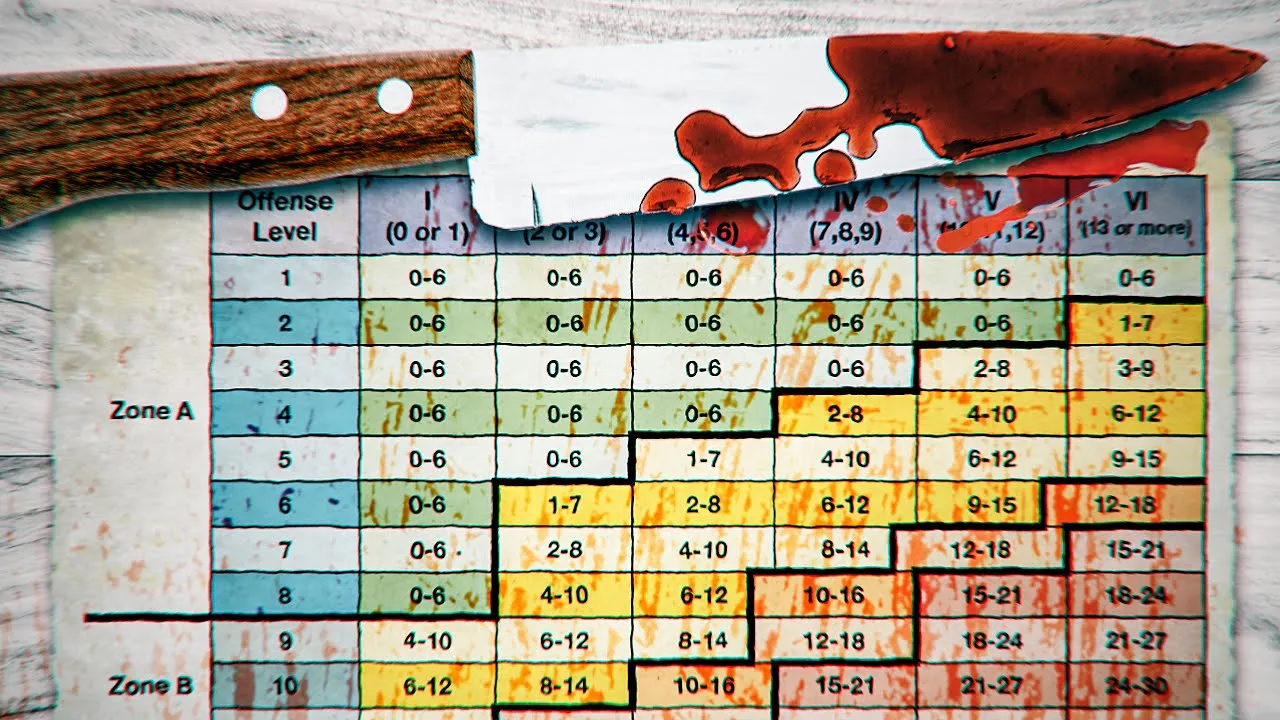
The answer is yes -- and no. When Marvin Frankel conceived of a justice system that would remove bias and variations in sentencing from United States federal sentencing, he was convinced that he’d ushered in a new, fairer regime of sentencing. In a way, he had… when Congress passed the Sentencing Reform Act of 1984, criminal sentencing became significantly more consistent. But it also opened the door to even more sinister discrimination with mandatory minimums and disparate impacts on minorities -- precisely some of the problems the sentencing reform was meant to address. It also rendered useless the professional experience of judges and ran complex crimes, and their victims, through a dispassionate algorithm that failed to tailor results to specific circumstances.
Justice is hard, and we continue to figure out how to do it right. Maybe it can be based on numbers. Maybe it should be based on feelings. And maybe it’s just impossible to achieve perfect justice.
*** ADDITIONAL READING ***
Marvin Frankel, “Criminal Sentences: Law Without Order”: https://www.amazon.com/Criminal-Sentences-Law-Without-Order/dp/0809013746
Chapman v. United States, Supreme Court transcript: https://www.supremecourt.gov/pdfs/transcripts/1990/90-5744_03-26-1991.pdf
New York Times review of Frankel’s “Law Without Order,” 1973: https://timesmachine.nytimes.com/timesmachine/1973/05/13/90954511.html?pageNumber=342
“Measuring Interjudge Sentencing Disparity: Before and After the Federal Sentencing Guidelines,” The Journal of Law & Economics, 1999: https://www.jstor.org/stable/10.1086/467426
The Sentencing Project: https://www.sentencingproject.org/
*** LINKS ***
Vsauce2:
TikTok: https://www.tiktok.com/@vsaucetwo
Twitter: https://twitter.com/VsauceTwo
Facebook: https://www.facebook.com/VsauceTwo
Talk Vsauce2 in The Create Unknown Discord: https://discord.gg/tcu
Vsauce2 on Reddit: https://www.reddit.com/r/vsauce2/
Hosted and Produced by Kevin Lieber
Instagram: https://instagram.com/kevlieber
Twitter: https://twitter.com/kevinlieber
Podcast: https://www.youtube.com/thecreateunknown
Research and Writing by Matthew Tabor
https://twitter.com/TaborTCU
Editing by John Swan
https://www.youtube.com/channel/UCJuSltoYKrAUKnbYO5EMZ2A
Huge Thanks To Paula Lieber
https://www.etsy.com/shop/Craftality
Vsauce's Curiosity Box: https://www.curiositybox.com/
#education #vsauce #crime
Science & Technology
#vsauce
#vsauce2
#vsause
#vsause2
#criminal justice reform
#criminal justice
#criminal justice system
#true crime video essay
#vsauce crime
#vsauce2 crime
#criminal sentencing
#criminal sentencing disparity
#criminal sentencing in the united states
#criminal sentencing algorithm
#crime theories criminology
#crime theory examples
#crime theories
#crime theory sociology
#justice course
#justice course harvard
#justice crash course
#true crime
#why mathematicians won't help cops