Pascal's Coin Flipping Cheat Sheet #shorts
 Vsauce2
Jun 7, 2022 17:52
Create an account to hide videos, mark them watched, or save them to Don't Miss.
Create an account to hide videos, mark them watched, or save them to Don't Miss.
Create an account to hide videos, mark them watched, or save them to Don't Miss.
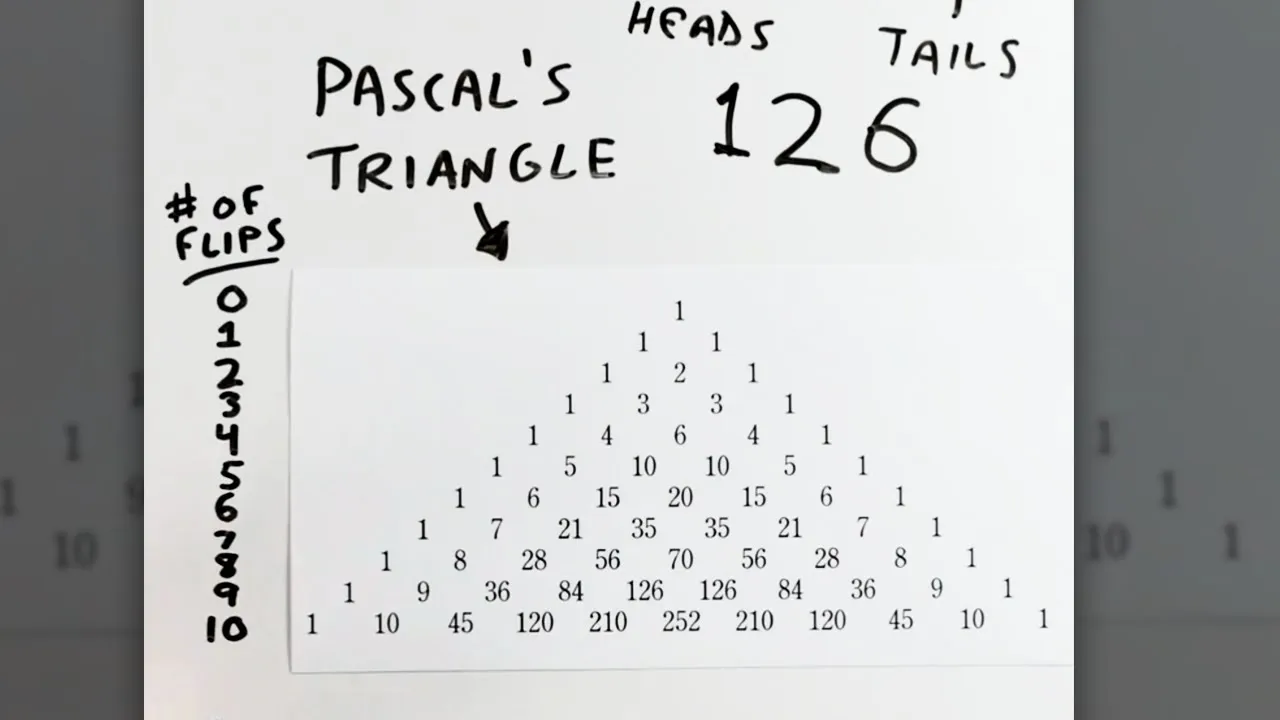
Blaise Pascal's Triangle displays the array of binomial coefficients in a triangle that holds a different meaning from seemingly every angle. From the odd numbers creating a fractal similar to the Sierpinski triangle to generating a full Fibonacci Sequence, Pascal's triangle portrays mathematical beauty -- and also keeps track of coin flips. Buried in the layers is a perfect expansion of probabilities of binomial outcomes that goes on forever.
And although we refer to it as Pascal's Triangle, it's not actually Pascal's. Mathematicians in China, India, Persia, and even France centuries before Pascal completed his Treatise on Arithmetical Triangle in 1665.
GET FLIPPING.
#education #mathss #shorts
Education
#vsauce
#vsauce2
#vsause
#vsause2
#pascals triangle
#coin flip
#pascals triangle probability
#pascals triangle coin toss problem
#pascals triangle coin toss probability
#pascals triangle coin toss
#pascals triangle probability examples
#how to use pascals triangle for probability
#pascals triangle probability example
#coin toss
#pascals triangle binomial expansion
#pascals triangle to expand
#pascals triangle example
#pascals triangle fibonacci sequence
#pascals triangle history