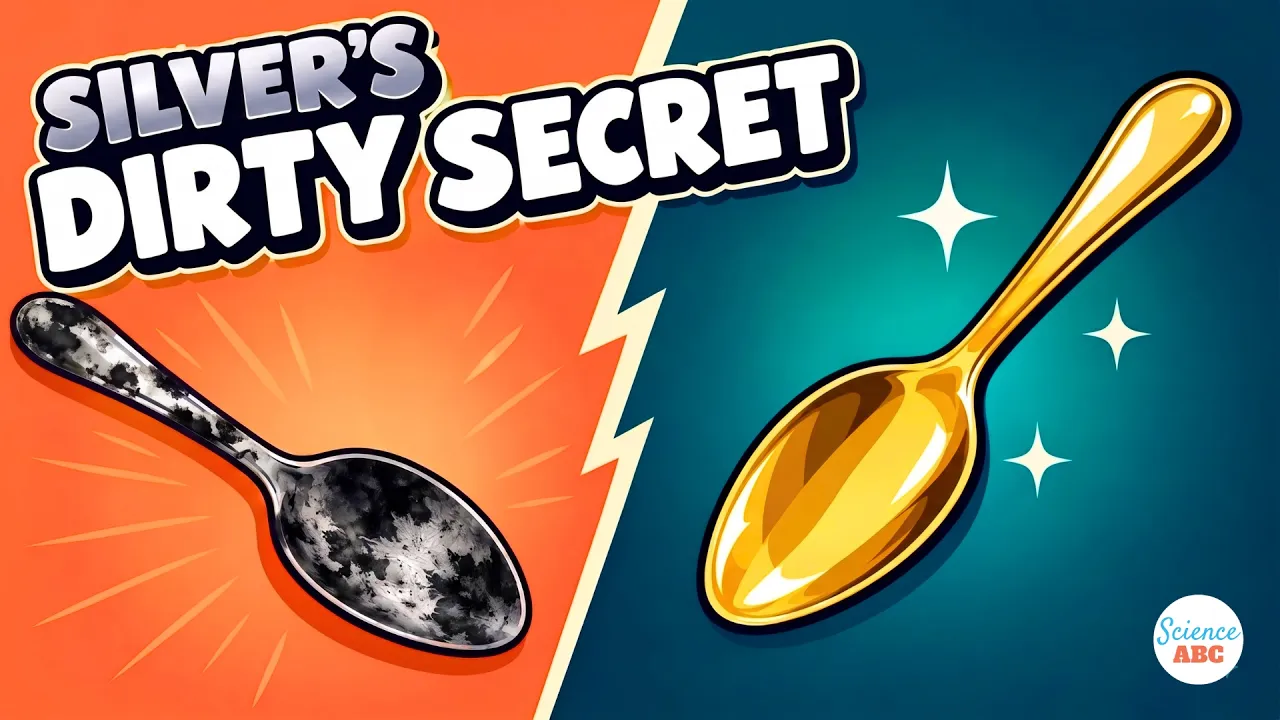
Why Does Silver Turn Black While Gold Does Not? Explained in Simple Words
 Science ABC
Sep 9, 2026 11:00
Create an account to hide videos, mark them watched, or save them to Don't Miss.
Create an account to hide videos, mark them watched, or save them to Don't Miss.
Create an account to hide videos, mark them watched, or save them to Don't Miss.
Chapters
Why does silver turn black while gold stays shiny forever? In this video, we explain in simple words why silver tarnishes and gold does not. You'll learn why the black layer on silver is not rust, how traces of hydrogen sulfide in ordinary air turn silver into black silver sulfide, why gold is called a noble metal, and the surprising real answer to gold's unreactivity: Albert Einstein's theory of relativity. Along the way, you'll discover why that same relativistic effect makes gold yellow and mercury liquid, and why gold coats the connectors inside your phone and the visors of astronaut helmets.
Whether you're a chemistry student, a curious science fan, or someone who just found a blackened silver spoon in a drawer, this explainer breaks down tarnish, noble metals, and relativistic chemistry into ideas anyone can follow.
CHAPTERS:
WATCH NEXT:
▶ Atomic Models Explained – https://youtu.be/v48u8hjqNBU
▶ Time Dilation and Einstein's Relativity – https://youtu.be/yuD34tEpRFw
▶ Isotopes Explained – https://youtu.be/oj2Wl83NytU
KEY TOPICS COVERED:
• Why silver tarnishes and turns black
• Tarnish vs rust: sulfur vs oxygen reactions
• Hydrogen sulfide and the formation of silver sulfide
• Why gold is a noble metal that reacts with almost nothing
• Relativistic effects in gold's electrons (Pekka Pyykkö)
• Why gold is yellow and mercury is liquid at room temperature
• Gold in electronics, phone connectors, and astronaut visors
#Silver #Gold #Tarnish #Chemistry #Relativity #ScienceABC
REFERENCES:
1. Pyykkö, P. (2004). "Theoretical Chemistry of Gold." Angewandte Chemie International Edition, 43(34), 4412–4456. https://doi.org/10.1002/anie.200300624
2. Pyykkö, P. (2012). "Relativistic Effects in Chemistry: More Common Than You Thought." Annual Review of Physical Chemistry, 63, 45–64. https://doi.org/10.1146/annurev-physchem-032511-143755
3. Norrby, L. J. (1991). "Why is mercury liquid? Or, why do relativistic effects not get into chemistry textbooks?" Journal of Chemical Education, 68(2), 110–113. https://doi.org/10.1021/ed068p110
4. Graedel, T. E. (1992). "Corrosion Mechanisms for Silver Exposed to the Atmosphere." Journal of the Electrochemical Society, 139(7), 1963–1970. https://doi.org/10.1149/1.2221162
SUBSCRIBE for more science explainers!
https://www.youtube.com/channel/UCcN3IuIAR6Fn74FWMQf6lFA?sub_confirmation=1
Follow us:
Twitter: https://twitter.com/abc_science
Facebook: https://facebook.com/sciabc
Instagram: https://www.instagram.com/scienceabcofficial/
Website: https://www.scienceabc.com
Copyright Science ABC. For licensing inquiries: [email protected]
Science & Technology
#chemistry explained
#einstein relativity
#gold chemistry
#gold noble metal
#hydrogen sulfide
#noble metals
#periodic table
#relativistic effects gold
#relativity chemistry
#science ABC
#science explained
#silver chemistry
#silver sulfide
#silver tarnish
#tarnish vs rust
#why does silver tarnish
#why does silver turn black
#why gold doesn't tarnish
#why is gold yellow
#why is mercury liquid