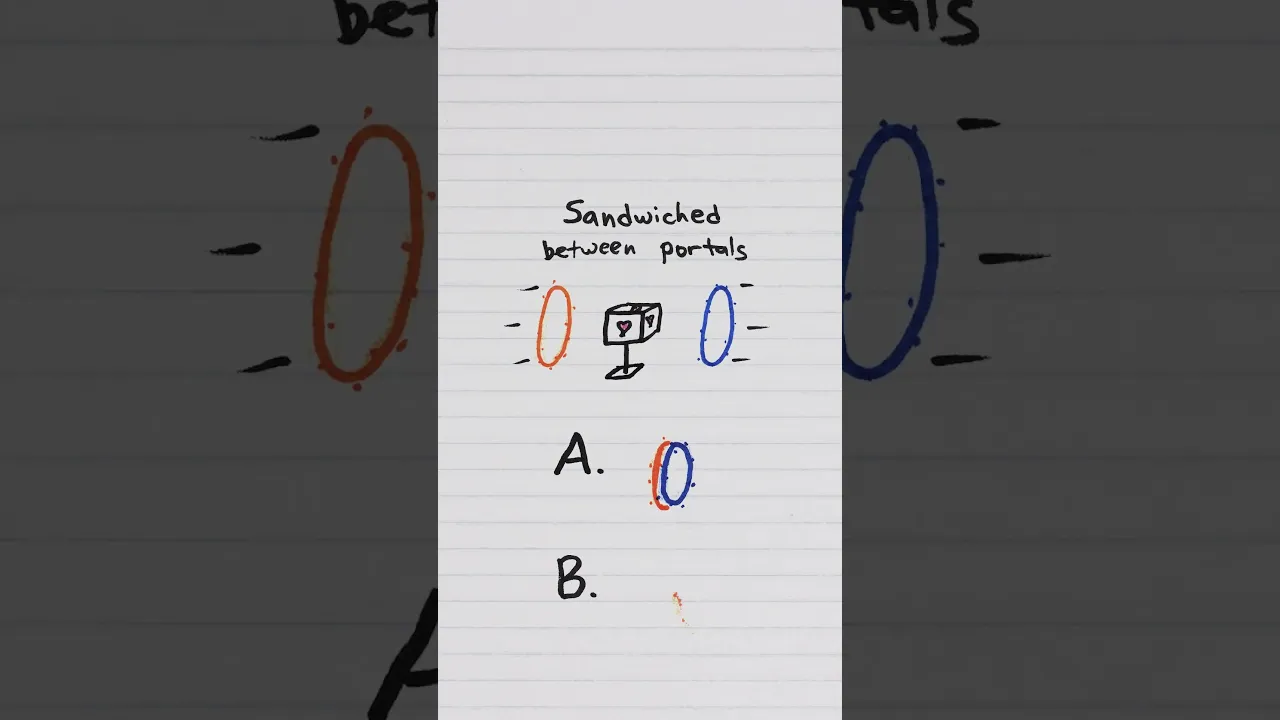
What if you try to sandwich a cube between two portals?
 minutephysics
Oct 10, 2026 19:00
Create an account to hide videos, mark them watched, or save them to Don't Miss.
Create an account to hide videos, mark them watched, or save them to Don't Miss.
Create an account to hide videos, mark them watched, or save them to Don't Miss.
Full Video: https://www.youtube.com/watch?v=zDAE9A_1NA4
What if you try to sandwich a cube between two portals?
Does the cube disappear?
Do the portals bounce or stop?
Or something else?
Imagine instead that you extend a piston through the blue portal.
Eventually it comes back and hits itself from behind.
The piston can't keep extending into the portal because there is no "inside" of the portal - "inside" the blue portal is "outside" the orange portal, and vice versa.
At this point one of three things could happen.
If the piston is weak it should crumple, the same as if it were pushing against a solid wall.
If the piston is rigid and the portals are super heavy, then the piston will just stop expanding (since it can't lengthen any more without the portals moving farther apart).
But the orange portal is clearly "pushing" the piston out of it to the right, so Newton's "equal and opposite" law of motion means the piston is pushing the orange portal to the left - "kind of like what happens when you throw a ball".
Similarly, the blue portal is somehow absorbing the momentum of the piston entering it, and so should be pushed to the right - like what happens when you catch a ball.
So if the portals aren't heavy (and aren't on super heavy objects), then the logical (if weird) conclusion is that the portals themselves get pushed apart!
Minute Physics provides an energetic and entertaining view of old and new problems in physics -- all in a minute!
Created by Henry Reich
Science & Technology
#physics
#minutephysics
#science