HDRP RTAO vs. HTrace RTAO V2 Temporal Rejection Comparison [Unity]
 IPGames
Apr 9, 2026 16:17
Create an account to hide videos, mark them watched, or save them to Don't Miss.
Create an account to hide videos, mark them watched, or save them to Don't Miss.
Create an account to hide videos, mark them watched, or save them to Don't Miss.
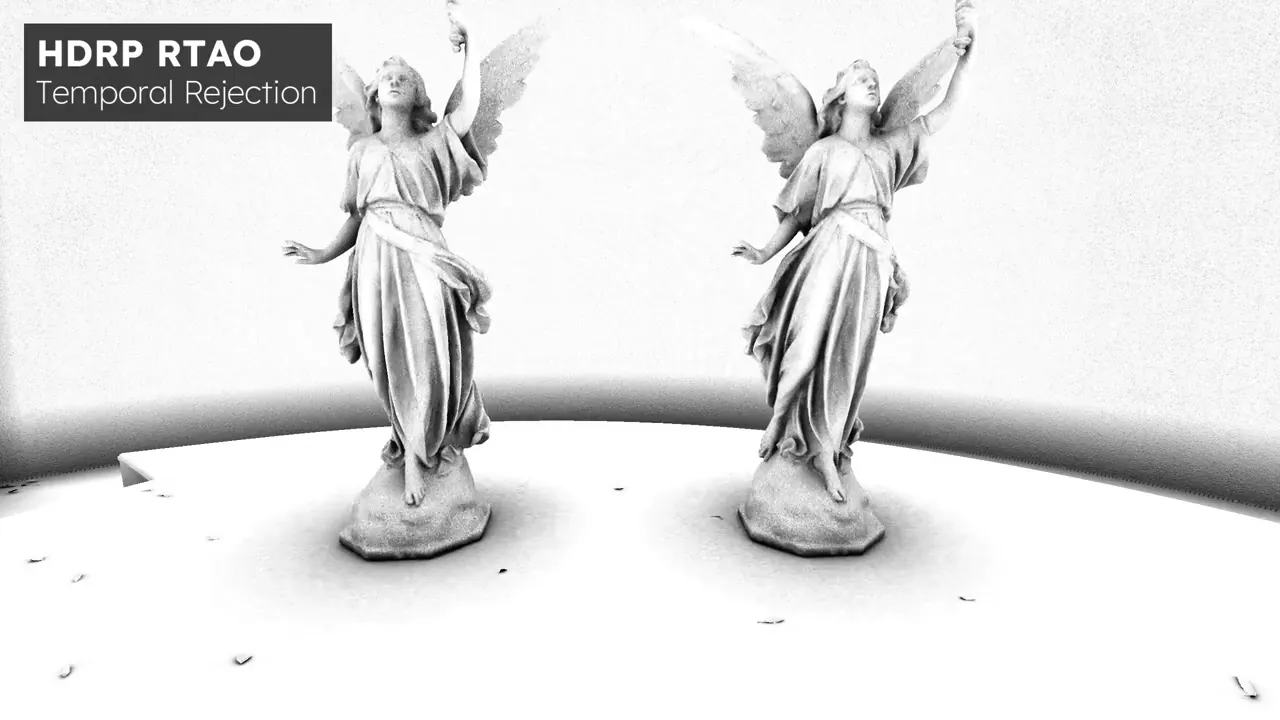
HDRP RTAO provides binary rejection options: Occluder Motion Rejection and Receiver Motion Rejection, which are simple checkboxes — either on or off. When enabled, HDRP completely discards temporal accumulation for AO cast from moving objects onto static ones (e.g. occlusion from a statue cast onto the floor) and onto themselves (e.g. the surface of a statue). This is why in this example we see essentially no temporal denoising on the moving statues or the occlusion they cast, leading to excessive and unnecessary noise.
HTrace RTAO, on the other hand, tracks the speed of moving objects and the direction of their movement, and is able to reject temporal history adaptively. In this example, it strongly rejects only the occlusion cast by a fast-moving statue onto the floor beneath it. The occlusion of the slowly moving statue, as well as the occlusion the statues cast onto themselves, is rejected less aggressively or not at all — because in these cases the delta between the caster and the receiver is considered small enough.
Spatial denoising is reduced to a minimum in both cases here, to better demonstrate the temporal accumulation process.
Support us on Patreon: https://www.patreon.com/htrace
Our assets: https://assetstore.unity.com/publishers/62914
#ao #ambientocclusion #unity #hdrp #urp #birp #builtin #highdefinition #hbao #gtao #lighting #ssao #ambient #occlusion #imageeffect #raytracing #gi #postprocessing #rtao #shadows #vxao #ue #ue5
Gaming
#HTrace
#Ray Tracing
#GI
#Unity
#Assets
#Lighting
#Rendering
#Indirect
#AO
#Ambient Occlusion
#SSAO
#GTAO
#RTAO
#HBAO
#VXAO
#Occlusion