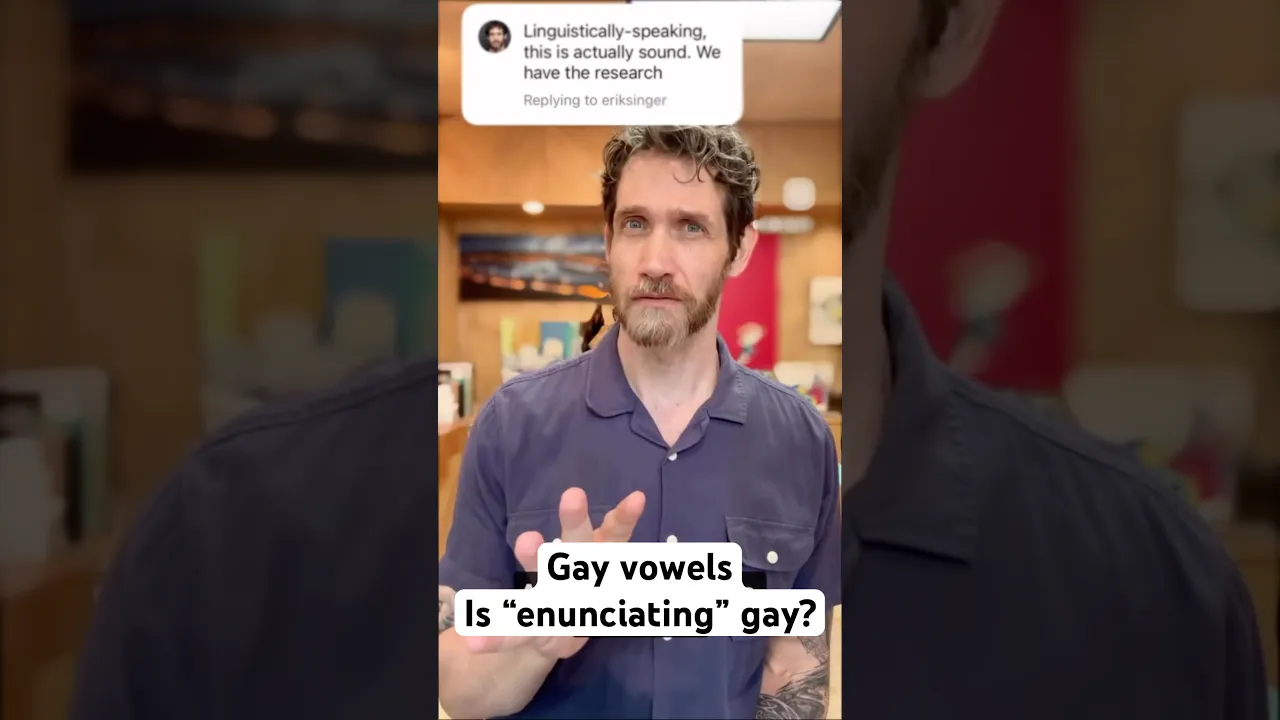
Are some vowel sounds gayer than others? Here's what the #linguistic research has to say. #accents
 Dialect Coach Erik Singer
Sep 5, 2025 18:14
Create an account to hide videos, mark them watched, or save them to Don't Miss.
Create an account to hide videos, mark them watched, or save them to Don't Miss.
Create an account to hide videos, mark them watched, or save them to Don't Miss.
There have been lots of requests for (1) sources, as well as many, many questions about (2) whether this phenomenon exists in other languages. Sources below, a partial answer to (2) in the comments.
(1) Not an exhaustive list, but some particularly clear and helpful sources are:
Pierrehumbert, Bent, Munson, Bradlow, & Bailey (2004), The influence of sexual orientation on vowel production, Journal of the Acoustical Society of America
Simpson and Weirich (2020), Phonetic Correlates of Sex, Gender and Sexual Orientation, Oxford Research Encyclopedia of Linguistics
Heffernan, K. (2010). Mumbling is macho: Phonetic distinctiveness in the speech of American radio DJs. American Speech
Munson, Benjamin; Babel, Molly (2007). "Loose Lips and Silver Tongues, or, Projecting Sexual Orientation Through Speech". Language and Linguistics Compass. 1 (5): 416–449
Podesva, Robert J. (2011). "The California Vowel Shift and Gay Identity". American Speech.
Munson, Crocker, Pierrehumbert, Owen-Anderson, & Zucker (2015), Gender typicality in children’s speech: A comparison of boys with and without gender identity disorder, The Journal of the Acoustical Society of America
Rogers,H., Jacobs, G., & Smyth, R. (2001). Searching for Phonetic Correlates of Gay- and Straight-Sounding Voices. Toronto Working Papers in Linguistics
Linville, S. (1998). “Acoustic correlates of perceived versus actual sexual orientation in men’s speech,” Folia Phoniatr. Logo.
Film & Animation